

Some ideas start with a strategy document.
Others start with a coffee.
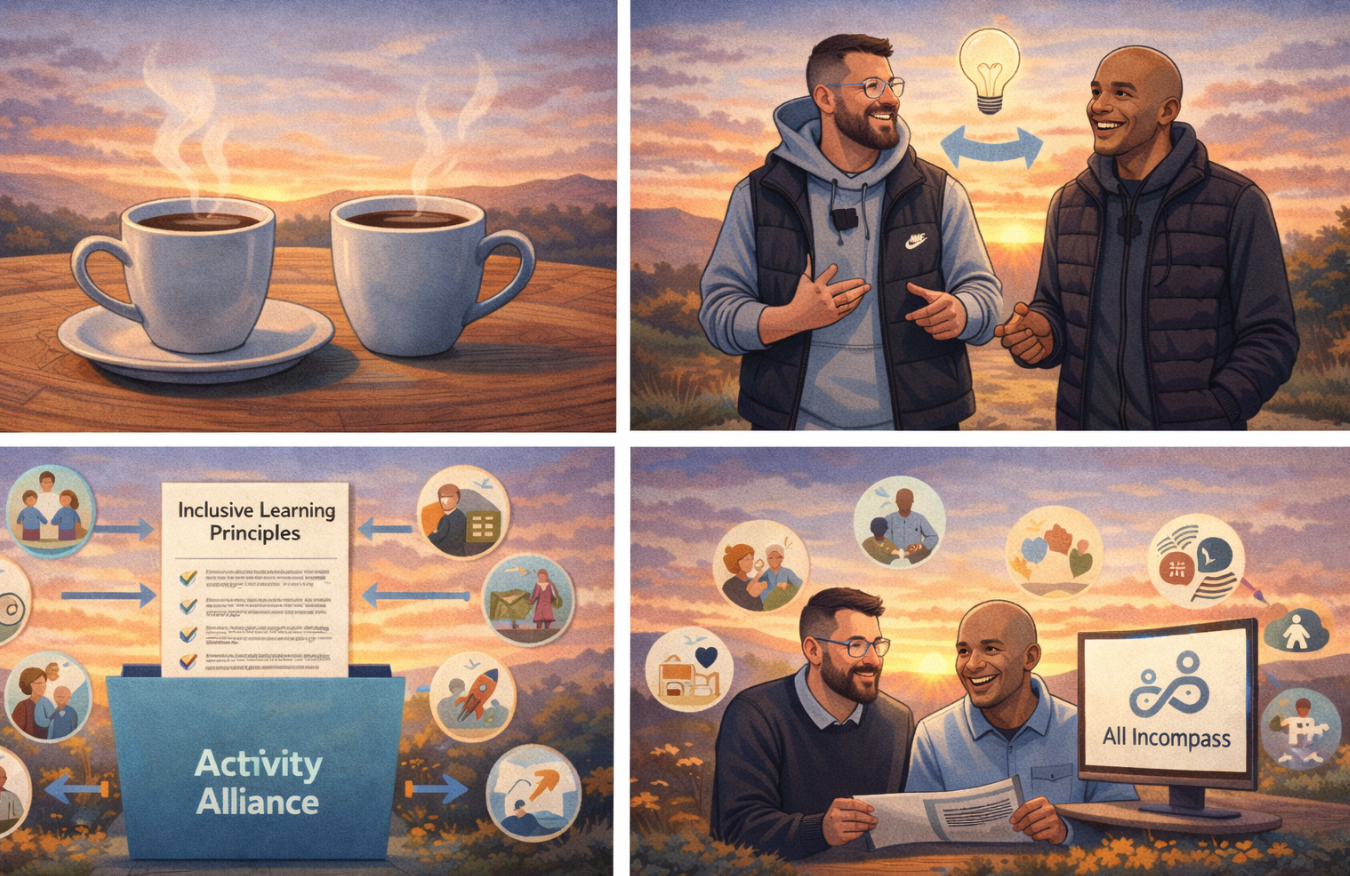
All Incompass began with the second.
Not in a boardroom, not with a pitch deck, and definitely not with a five-year plan. Just two blokes of roughly the same age — Andy Heald and Trevor Dias, sitting down for a coffee and talking about life, work, family, and the strange balancing act that comes with trying to build something meaningful while life keeps moving around you.
The conversation started, as many do, with work.
We were talking about the sport, childcare and wraparound sector, the challenges providers face, the pressure on organisations, and the systems that often seem to make life harder rather than easier.
But like most honest conversations, it didn’t stay neatly inside the boundaries of work.
It drifted into the bigger stuff.
Parenthood. Responsibility. Mental health. Trying to be a good dad, a decent partner, a reliable friend, and still somehow run a business without losing yourself along the way.
Anyone who has lived that balancing act will recognise it immediately.
For Andy, that journey had already included navigating his own mental health challenges, the kind many men quietly carry while still trying to show up for everyone else. Being a dad, running businesses, and trying to keep everything moving forward has a way of sharpening your perspective.
It makes you ask different questions.
Not just what works.
But what actually matters.
Trevor understood that instinctively.
Two men of a similar age, with similar responsibilities, sitting there asking a deceptively simple question:
“Surely there has to be a better way than this?”
At some point during that conversation, Matt Ogle name came up.
And that’s when things started to take shape.
Matt and Trevor both have children with additional needs, and that lived experience brought a different weight to the conversation. It moved inclusion out of the abstract and into real life. Because when accessibility affects your child, your family, your everyday decisions, it stops being theoretical.
It becomes personal.
Suddenly, the discussion about systems, learning and opportunity wasn’t just about improving processes. It was about making sure the environments we create, in sport, physical activity, childcare and learning, genuinely work for the people who rely on them.
Looking back, it’s tempting to dress that moment up as some kind of carefully orchestrated business origin story.
But the truth is simpler.
It was a conversation.
A chance alignment of experience, frustration, and purpose.
The universe, if you like, is putting the right people in the same place at the right time.
And that conversation became the beginning of All Incompass
When Life and Work Collide
Businesses often start with a market opportunity.
This one started with lived experience.
Between the three of us, we had spent years working across the sport, physical activity, childcare and corporate sectors. We had seen the good work happening every day, ethical leaders, passionate providers, committed coaches, and organisations trying to make a difference in their communities.
But we had also seen the friction.
Systems that didn’t quite fit how people actually worked.
Learning environments that unintentionally exclude people.
Processes that created barriers rather than removed them.
And too often, organisations are forced to navigate technology or consultancy services that seemed designed more for extraction than support.
One provider once joked to us:
“It sometimes feels like we’re paying someone for the privilege of doing our own admin.”
There was humour in that comment, but also truth.
The sector deserved better tools. Better support. Better thinking.
So we started asking a different kind of question.
What would happen if systems were designed from the perspective of the people using them?
Not from the platform developer’s perspective.
Not from the perspective of a corporate sales model.
But from the perspective of the coach, the provider, the parent, and the child.
That question eventually became the foundation for All Incompass.
But at the time, we didn’t know that yet.
We were still just talking.
A Wider Movement Taking Shape
Around the same time, another piece of the puzzle was forming.
Through Andy’s work Sporting People Ltd alongside Stephen Mitchell, there was growing collaboration with organisations working to improve inclusion across sport and physical activity. One of the most important of these collaborations involved Activity Alliance, a leading voice advocating for inclusive participation and workforce opportunities.
Activity Alliance had been working with sector partners, including CIMSPA Sport England Active Partnerships and UK Coaching, to develop a new framework designed to make learning and workforce development more inclusive.
The result was the #Inclusive Learning Principles.
These principles were created to help organisations design learning environments that genuinely work for everyone, particularly disabled people and those who have historically faced barriers to training and employment in sport and physical activity.
The context for this work is important.
Research has consistently shown that disabled people remain significantly under-represented in the physical activity workforce. Many individuals want to enter the sector but face barriers to training, confidence or accessible learning environments.
The goal of the principles is simple but powerful:
- Make inclusion inevitable by designing it into learning from the start.
- Not as an afterthought.
- Not as a reaction.
But as the foundation.
What the Principles Stand For
The Activity Alliance Inclusive Learning Principles provide a framework for designing and delivering learning that is accessible, relevant and empowering.
They encourage organisations to ensure that learning environments are:
- Inclusive by design Not retrofitted once barriers appear.
- Led by lived experience Listening to disabled people and learners to shape learning experiences.
- Grounded in the real world Linking learning to actual roles, environments and challenges.
- Accessible from the outset Ensuring resources, systems and environments work for everyone.
- Communicated clearly and positively Using plain language and inclusive imagery.
- Flexible and person-centred Recognising that everyone learns differently.
- Focused on growth and challenge Supporting learners to develop confidence and capability.
- Collaborative Creating spaces where learning happens together.
- Reflective Encouraging people to connect ideas to practice.
- Continuously improving Adapting and evolving learning over time.
At first glance, none of these principles seems revolutionary.
In fact, most people working in the sector would probably read them and think:
“Well… yes. That’s how it should work.”
And that’s precisely the point.
Because the gap has never been in recognising what good looks like.
The gap has been in designing systems that actually make it possible.
Turning Principles into Practice
This is where the All Incompass story starts to intersect with the principles in a meaningful way.
When we eventually began building the All Incompass platform and consultancy services, we were not trying to build another piece of software.
We were trying to solve a practical problem.
Across the sector, providers face constant operational pressure.
- Managing bookings.
- Handling payments.
- Communicating with families.
- Tracking attendance.
- Managing compliance requirements.
- Supporting children and participants with different needs.
Many of the tools available to support this work were not built with the realities of the sector in mind.
- Some were overly complicated.
- Some were financially aggressive.
- Some simply did not understand the environments they were operating in.
So we asked ourselves a simple question:
What would a system look like if it was designed around the same principles we were talking about in inclusive learning?
What would it look like if accessibility, simplicity and fairness were built in from the start?
That thinking shaped the All Incompass platform.
Technology That Removes Friction
Technology should make life easier.
That sounds obvious.
But anyone who has spent time navigating clunky systems knows that it doesn’t always happen that way.
The goal for All Incompass was to build something that genuinely removed friction for providers, families and participants.
That meant designing with real-world usage in mind.
- Simple booking journeys.
- Clear communication.
- Flexible systems that could adapt to different settings.
- Transparent pricing that didn’t punish organisations for growing.
In other words, technology that worked with providers, not against them.
Because inclusion is not just about learning design.
It also shows up in everyday systems.
If a parent struggles to understand how to book a session, that is an inclusion issue.
If a provider cannot adapt a system to support a child with additional needs, that is an inclusion issue.
If organisations feel trapped by the cost structures of the systems they rely on, that too becomes a barrier.
Removing those barriers is part of the same conversation.
Consultancy Built on Experience
Alongside the technology, All Incompass also developed consultancy services to support organisations working across sport, childcare and wraparound provision.
This work covers areas such as:
- Ofsted readiness
- Inclusive programme design
- SEND support
- Business Growth
- Leadership
- Operational systems
- Workforce development
- Recruitment and retention strategies
But the consultancy approach is deliberately grounded in lived experience.
Because theory alone rarely solves real-world problems.
The combination of professional expertise and lived experience, both personal and sector-wide, allows conversations to happen at a different level.
Less “consultant to client”.
More “practitioner to practitioner”.
More honest.
More practical.
More useful.
Ethical by Design
One of the earliest decisions we made was that the business itself had to reflect the values we were talking about.
Too many systems in the sector operate on models that quietly take more and more from organisations already under pressure.
That was never the intention here.
The goal was to create services that were:
- Transparent.
- Fair.
- Sustainable.
- Supportive.
Because if we were serious about inclusion, it could not stop at learning environments.
It had to extend to the way organisations operate.
Why the Principles Matter Now
The introduction of the Activity Alliance principles marks an important moment for the sector.
They provide a shared language for what inclusive learning should look like.
More importantly, they shift the conversation away from aspiration and towards expectation.
Inclusive practice should not be optional.
It should be the standard.
For All Incompass, these principles align closely with the values that shaped the organisation from the beginning.
Not because we set out to build something around them.
But because the same instincts that led to that original coffee conversation are reflected in the principles themselves.
Listen to lived experience.
Design systems that work in the real world.
Remove barriers instead of creating them.
Continuously learn and improve.
Those ideas apply just as much to technology and consultancy as they do to learning design.
A Better Way Forward
Looking back, it is tempting to see neat lines connecting everything.
Coffee – Conversation – Shared experiences – Inclusive learning principles – A platform – A consultancy.
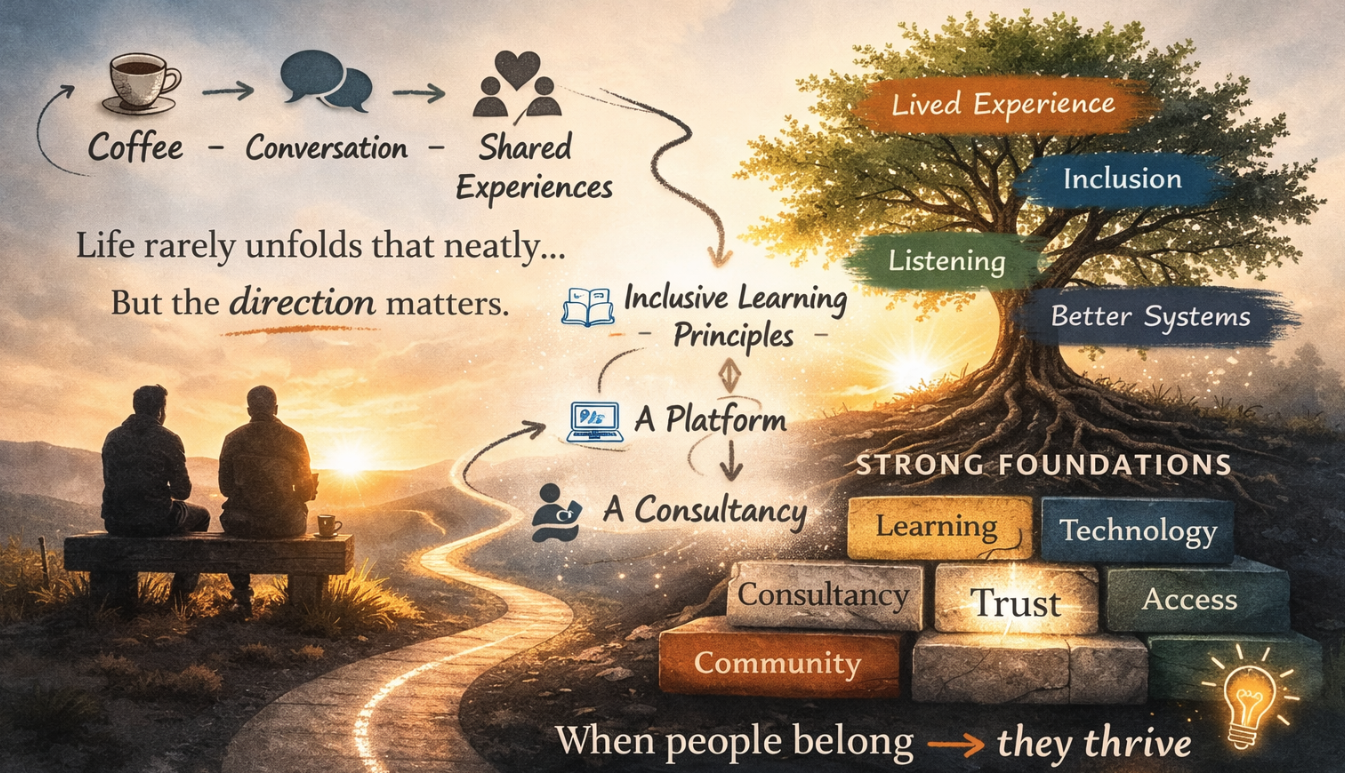
But life rarely unfolds that neatly.
What matters more is the direction.
The commitment to building systems that are thoughtful, practical and inclusive.
The willingness to listen to lived experience.
And the belief that the sector deserves tools and support that genuinely help.
That is the spirit behind All Incompass.
And it is why we are proud to champion the Activity Alliance Inclusive Learning Principles.
Because when inclusion is designed into the foundations, whether that is learning, systems or organisations, something powerful happens.
People feel they belong.
And when people belong, they thrive.